 My Roofing Tech
2024 IECC Commercial Roofing Impacts for Property Managers
Quick Answers for Property & Facility Managers
How will the 2024 IECC affect the cost of my next commercial roofing project?
The U.S. DOE analysis cited by NRCA indicates the 2024 IECC will materially increase construction costs, driven by stricter envelope, insulation and energy-efficiency requirements. For commercial roofs, expect higher upfront costs for insulation, air barriers and cool-roof measures, but improved long-term energy performance.
Do commercial roof replacements now have to meet current IECC energy standards?
Many jurisdictions require commercial roof replacements to comply with the IECC in effect at the time of the project, not the original building code.[5] This typically means upgrading insulation, addressing thermal bridges and air leakage, and verifying that roof assemblies meet current energy and cool-roof provisions rather than legacy standards.
What specific 2024 IECC changes matter most for commercial roof systems?
Key 2024 IECC changes for commercial roofs include a defined building-envelope air leakage target, expanded air-barrier provisions, and required energy-efficiency credits that can involve roof insulation and reflective surfaces.[1][3][9] These changes increase design complexity and may raise material and testing costs for low-slope commercial roof projects.
2024 IECC, DOE Cost Concerns, and Why Commercial Roofs Are in the Spotlight
The National Roofing Contractors Association (NRCA) recently highlighted a U.S. Department of Energy (DOE) analysis showing that adoption of the 2024 International Energy Conservation Code (IECC) would significantly increase housing construction costs. Although this analysis focuses on residential construction, the 2024 IECC also introduces more stringent commercial building-envelope and energy-efficiency provisions that directly affect commercial roof design and replacement.[2][8]
For property managers, facility managers, and building owners, these changes mean roof projects will increasingly be driven by energy code compliance—insulation levels, air barriers, and cool-roof strategies—rather than only leak response and lifecycle cost. Jurisdictions that adopt the 2024 IECC commonly align commercial and residential energy requirements, so you should expect parallel tightening of standards across your office, retail, industrial, healthcare, and multifamily portfolios.[1][6][8]
The IECC works alongside the International Building Code (IBC roofing provisions), ASHRAE 90.1 for commercial energy standards, and insurer requirements such as FM Global, while NRCA serves as a key technical resource for roofing practices. Understanding how these overlapping requirements interact at the roof level is now essential to budgeting, capital planning, and risk management.
Stricter Building-Envelope and Air-Leakage Requirements Over Roof Areas
The 2024 IECC strengthens building-envelope provisions, including explicit air-leakage performance targets and installation requirements that apply to roof assemblies over conditioned space.[3][9] Commercial buildings must now demonstrate tighter air leakage, with testing or detailed inspection of air-barrier installation in many occupancies.[3]
According to envelope training materials on the 2024 IECC, the code sets a target maximum building-envelope air leakage rate and provides methods for verifying compliance, including whole-building air-leakage testing or assembly-based testing over representative portions of the roof and walls.[3][9] When testing is not required, roofs must still comply with air-barrier installation rules, so you cannot treat the roof as a purely weatherproofing layer; it is a critical part of the energy-control assembly.
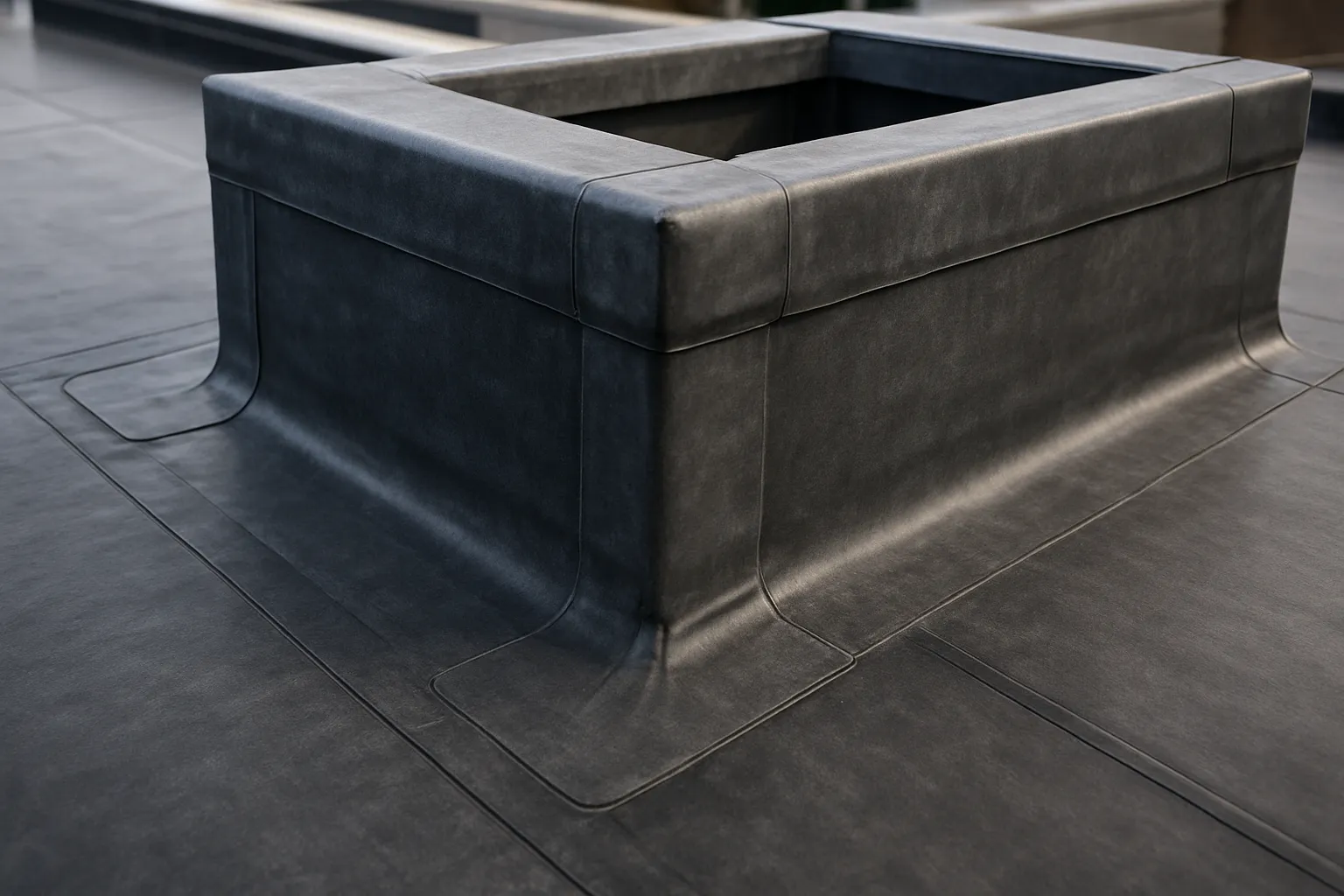
NRCA guidance on purposeful rooftop design notes that the 2024 IECC recognizes certain roofing materials and substrates as air barriers, such as adequately thick plywood, oriented strand board, extruded insulation boards, and specific membrane systems.[2] However, simply having these materials present is not enough—detailing at penetrations, parapets, expansion joints, flashings, and transitions must be designed and installed to meet the tighter leakage thresholds.
For building owners and facility managers, this means:
- Roof replacement projects may require air-leakage testing or documented air-barrier installation over conditioned areas.
- Roof details (curbs, drain sumps, parapet connections, wall-to-roof transitions) will receive more scrutiny from code officials, consultants, and insurers.
- Poorly detailed or undocumented roofs can delay inspections, occupancy, or warranty approval.
In practical terms, roof specifications that previously focused on membrane type (TPO, PVC, EPDM, modified bitumen, BUR, metal) must now explicitly address air-barrier continuity and testing strategy for IECC compliance.
Insulation Levels, Thermal Bridging, and Cool-Roof Strategies Under the 2024 IECC
Commercial roofs have long been a primary path for reducing heat loss and heat gain in buildings, and the IECC reinforces this role. While specific R-values for commercial roofs are driven by ASHRAE 90.1 and climate zone tables rather than residential attic requirements, updated IECC guidance emphasizes correct R-values, U-factors, and climate-zone alignment for roof assemblies.[10]
Energy-code resources summarizing IECC requirements note that commercial roofs typically follow ASHRAE 90.1-2019 baselines (for example, continuous insulation rather than attic-style R-49), and that misapplying residential standards is a common error.[10] At the same time, 2024 IECC commercial training materials highlight concern about thermal bridges at structural and attachment elements, with some roof attachments such as flashing and coping specifically discussed in the context of thermal-bridge exemptions.[3][9]
For owners and facility managers, this translates into several design and budgeting implications:
- Higher or more carefully configured roof insulation may be needed when your jurisdiction updates to the 2024 IECC or related standards.
- Designers will pay more attention to thermal bridges at steel deck flutes, fasteners, purlins, structural members, and parapet details, potentially changing how insulation is layered and fastened.
- Cool-roof or reflective-roof strategies may be used to earn energy-efficiency credits in IECC point systems, especially in warm climates and in jurisdictions with additional requirements such as California Title 24.[1][5][10]
NRCA, ASTM roofing standards (such as testing for reflectivity and emissivity), and cool-roof programs all intersect here. The choice of TPO, PVC, coatings, or reflective metal panels can help meet IECC energy credits while also aligning with manufacturer warranties and FM Global criteria for hail, fire, and wind performance.
When planning projects, property managers should ask design professionals and roofing contractors:
- Which IECC/ASHRAE roof insulation values apply to each building and climate zone?
- How will thermal bridges be addressed or documented for code compliance?
- Will reflective membranes or coatings be used, and how do they impact long-term energy and maintenance costs?
Energy Credits, On-Site Renewables, and Roofs as an Energy Asset
A notable 2024 IECC development is the expanded use of energy credits and renewable-energy requirements for new commercial buildings.[1] The code’s commercial summary explains that buildings must achieve a minimum number of credits based on occupancy group, drawing from a menu of efficiency measures such as envelope enhancements, systems upgrades, and, in many cases, on-site or off-site renewable power generation.[1]
Crucially for building owners, the 2024 IECC calls for new buildings to generate renewable energy on-site where feasible, with options for off-site generation if on-site is not possible.[1] Roofs are often the most practical on-site location for solar arrays, meaning your roof design is now directly linked to energy-compliance strategy.
This has several implications:
- Structural and attachment design must support rooftop solar where used to satisfy IECC renewable requirements.
- Membrane selection (TPO, PVC, EPDM, modified bitumen, metal) should be evaluated for compatibility with solar mounting systems and long-term warranty coverage.
- FM Global and manufacturer guidelines for wind uplift, fire resistance, and hail impact must be reconciled with solar loading, penetrations, and cable routing.
Facility managers should coordinate early between roofing designers, solar consultants, and energy-code specialists to avoid conflicts—for example, membrane warranties voided by incompatible rack penetrations, or wind-uplift ratings compromised by ballast or attachment schemes.

Code Adoption, Commercial Roof Replacement, and Capital Planning Risk
Although the DOE analysis highlighted by NRCA focuses on housing costs, commercial portfolios will feel similar upward pressure on project costs as jurisdictions adopt newer IECC editions. Industry commentary on the 2024 IECC notes incrementally higher energy savings relative to the 2021 edition, alongside increased flexibility in some residential provisions.[6] For commercial buildings, the envelope and energy-credit structure still tends to increase material and design costs.
Regional guidance on IECC energy code compliance for commercial roof replacements emphasizes a critical point for property managers: roof replacements are generally required to meet current energy code standards, not the original construction standards.[5] In practice, this means that once your jurisdiction adopts the 2024 IECC or related amendments, any major roof replacement or recover project will trigger the newer insulation, air-barrier, and energy-credit requirements.
This can impact capital planning in several ways:
- Projects originally budgeted around a simple membrane replacement may need significant insulation upgrades and detailing changes.
- Permitting schedules can expand if designers must re-evaluate compliance against the latest IECC, IBC roofing provisions, and insurer criteria.
- Deferred maintenance strategies (repeated repairs instead of replacement) may need to be reconsidered if code-driven upgrades significantly change cost and ROI calculations.
Owners managing national portfolios should monitor IECC adoption timelines at the state and local level, recognizing that some jurisdictions adopt IECC editions with amendments or rely on ASHRAE 90.1 as an alternative compliance path. Coordination with code consultants, NRCA-member contractors, and design professionals is increasingly important.
Practical Actions for Property and Facility Managers Preparing for 2024 IECC Impacts
Given the DOE’s finding that the 2024 IECC will raise construction costs and the code’s tighter envelope requirements, building owners and facility managers can take several practical steps to manage risk and capture long-term value:
- Audit current roof assemblies and documentation
Compile as-built drawings, insulation thicknesses, membrane types, manufacturer warranties, and FM Global approvals for each property. This baseline helps designers quickly identify gaps relative to current IECC and ASHRAE 90.1 requirements. - Integrate energy-code compliance into roof asset management plans
When planning replacements or major recover projects, treat IECC and IBC roofing provisions as primary design drivers. Budget for additional insulation, air-barrier detailing, and possible leakage testing on conditioned buildings.[3][5][9] - Coordinate with insurers and warranty providers
FM Global guidelines, factory mutual approvals, and manufacturer warranties may impose requirements that interact with IECC provisions—especially around wind uplift, fire rating, hail resistance, and solar installation. Confirm that proposed assemblies satisfy all parties before construction. - Evaluate roof-related energy upgrades for ROI
Higher insulation levels and reflective roofs increase upfront cost but can reduce energy consumption and improve comfort. Work with energy modelers to quantify savings and, where applicable, capture IECC energy credits, local incentives, or utility rebates.[1][5][10] - Engage qualified design professionals and NRCA-member contractors
Complexities around thermal bridging, air leakage, and renewable integration make it critical to involve architects, engineers, and experienced commercial roofing contractors. NRCA publications and ASTM standards provide technical guidance that should be reflected in your project specifications.[2]
By aligning roof asset strategies with the evolving IECC landscape, property and facility managers can reduce compliance risk, avoid last-minute cost surprises, and position roofs as energy-performing assets rather than solely as waterproofing components.
Frequently Asked Questions
How should owners budget for commercial roofing under the 2024 IECC?
Owners should anticipate higher upfront costs driven by increased insulation, air-barrier detailing, potential leakage testing, and roof-ready solar infrastructure. However, these investments can improve energy performance and reduce operating costs. Work with designers to model savings and ensure assemblies align with IECC, ASHRAE 90.1, FM Global, and manufacturer warranty criteria.[1][5][6][9]
Do all commercial buildings have to undergo air-leakage testing under the 2024 IECC?
The 2024 IECC establishes an envelope air-leakage target and describes testing paths, but it also provides exceptions for certain building types and conditions.[3][9] Even when full testing is not mandated, roofs over conditioned spaces must comply with air-barrier installation provisions. Owners should confirm local requirements with code officials and design teams during project planning.
How do IECC, IBC, and ASHRAE 90.1 interact for commercial roof design?
The IECC sets energy-conservation requirements, often referencing ASHRAE 90.1 for commercial energy performance, while the IBC governs structural, fire, and general roofing provisions.[8][10] Roof assemblies must simultaneously satisfy all three frameworks, along with insurer and manufacturer criteria. Coordinated design and specification review is essential to avoid conflicts at permitting and warranty stages.
Are cool roofs or reflective membranes required by the 2024 IECC?
The IECC does not universally mandate cool roofs, but reflective membranes and coatings are frequently used to help meet energy-efficiency goals and credit systems, especially in warm climates and in jurisdictions with additional rules such as Title 24.[1][5][10] Owners should consider climate, building use, and maintenance implications when selecting cool-roof strategies.
Will my existing commercial roofs be grandfathered when the 2024 IECC is adopted?
Existing roofs are typically allowed to remain as-is until a major replacement or recover project triggers compliance with the current energy code.[5] Once you undertake significant work, the project must meet the IECC edition in force, potentially requiring insulation upgrades and air-barrier improvements. Proactive capital planning helps avoid unexpected cost escalations when codes change.
What role does NRCA play in navigating 2024 IECC changes for roofs?
NRCA provides technical guidance on commercial roofing practices and has highlighted the DOE’s findings on the cost impacts of the 2024 IECC.[2] Its publications help interpret how energy codes affect roof assemblies, air barriers, and insulation. Owners can leverage NRCA-member contractors and resources to ensure projects reflect current best practices and code requirements.
Related Reading on My Roofing Tech
- Commercial Drain Cleaning: Practical Roof Drain Maintenance for Facility Managers
- Section 179 Expensing and Commercial Roofing: What Property Managers Need to Know
Find a Qualified Commercial Roofing Contractor
Need help acting on this? Browse roofing contractors in your area, or explore commercial roofing services like preventative maintenance, inspections, and emergency response. Are you a contractor? List your business on My Roofing Tech to reach property and facility managers actively searching for help.