 My Roofing Tech
EV Charging Station Installation for Commercial Properties: Roof & Site Planning Guide
Quick Answers for Property & Facility Managers
How should a commercial property manager plan EV charging station installation for their building?
Start by assessing electrical capacity and parking patterns, then define goals (tenant amenity, revenue, ESG) and charger types. Engage a qualified EV charging provider and licensed electrician, confirm local codes and incentives, plan conduit routing around or through the roof, and protect TPO, PVC, EPDM, metal, and other systems with proper penetrations and flashing.[1][2][3][4]
What does EV charging station installation typically cost for commercial Level 2 chargers?
For most commercial Level 2 EV charging station installations, property owners typically invest about $6,000–$15,000 per charger, including equipment and installation.[3] Complex sites needing service upgrades, new transformers, or extensive trenching can exceed $100,000 when multiple chargers or fast-charging units are added.[3][4]
Why should building owners integrate roofing considerations into EV charging station installation?
EV charging station installation can require roof penetrations, equipment supports, and new conduit runs. Coordinating with your commercial roofing contractor protects waterproofing, avoids damage to TPO, PVC, EPDM, modified bitumen, BUR, and metal roofs, and ensures warranties and drainage performance are maintained during and after the project.
Why EV Charging Station Installation Matters for Commercial Roofed Properties
EV charging station installation has quickly shifted from a niche upgrade to a core amenity for office, retail, industrial, logistics, and healthcare properties.[4] Tenants, employees, and visitors increasingly expect on-site charging, and many investors now view EV infrastructure as part of ESG and modernization strategies.[2][4]
For property managers, facility managers, and building owners, charging projects intersect directly with the building’s electrical backbone, parking layout, and often the roof system. Whether your conduits pass over a TPO membrane or you’re mounting power equipment adjacent to a standing seam metal roof, coordination between EV designers, electrical engineers, and commercial roofing professionals is critical.
This guide focuses on how to plan EV charging station installation in a way that safeguards TPO, PVC, EPDM, modified bitumen, BUR, and metal roofs while maximizing long-term ROI.
Strategic Planning: Goals, Stakeholders, and Site Assessment
Successful EV charging station installation starts with a clear business case and a structured planning process.[1][2][3]
Clarify goals and stakeholders
Before design work begins, define why you are adding EV charging:[2][4]
- Tenant and employee amenity for offices, medical complexes, and corporate campuses.
- Customer attraction for retail centers, hotels, and mixed-use properties.[6]
- Fleet or operational support for logistics, municipal, or service facilities.[4]
- Revenue generation via paid charging sessions.[2][7]
- Sustainability and ESG positioning to support corporate or institutional goals.[2][4]
Secure internal buy-in by linking EV charging to net operating income (NOI), property value, and tenant retention.[1][4] Involve asset managers, facilities, leasing, and IT early so the design supports operations and future scaling.
Conduct a site and electrical assessment
Every commercial EV charging station installation begins with a technical site review:[1][2][3][4]
- Evaluate electrical capacity (service size, transformer capacity, spare panel space).[2][3]
- Map parking utilization and traffic flow to select the most-used and safest stalls.[3][6]
- Identify distance from electrical rooms to stalls to estimate conduit routes and trenching.[2][3]
- Check for required service or panel upgrades for Level 2 or fast charging.[3][4][8]
- Flag roof crossings where conduits may go up, over, or through low-slope roofs to reach exterior walls or parking structures.
Partnering with an experienced commercial EV provider or consultant streamlines this process and helps you model capacity, load management, and future expansion.[1][4][7]
Charger Types, Load Management, and Roof-Adjacent Equipment
Understanding charger types and load strategies will shape equipment locations and any roof impacts.
Select charger levels and quantities
Commercial properties generally deploy:
- Level 2 AC chargers (commonly 7–19 kW), suitable for offices, retail, and workplaces where vehicles remain parked for hours.[3][4][8]
- DC fast chargers (typically 50 kW and above, with "ultra-rapid" units up to 350 kW) for highway-adjacent sites, fleets, or time-sensitive users.[8][9]
Higher-power chargers demand more robust electrical infrastructure and may require larger gear near the building envelope, potentially adjacent to or over roof areas.
Use smart load management and software
Smart charging platforms and dynamic load balancing allow multiple chargers to share available capacity without overloading the system.[4][8] Key features include:
- Load management to distribute power across chargers.[4][8]
- Real-time monitoring and maintenance alerts.[4][2]
- Billing and access control integration.[4][2][9]
- Support for open standards such as OCPP/OCPI for future flexibility.[4]
For property teams, these tools reduce peak demand charges, simplify cost recovery, and support multi-tenant billing, all while coordinating with building BAS and energy management strategies.
Integrating EV Charging Station Installation With Commercial Roof Systems
Even when chargers are located at grade, the supporting infrastructure interacts with roof systems through conduit routing, equipment placement, and penetrations. Each roof type presents different risks and detailing requirements.
TPO and PVC membranes (thermoplastic single-ply)
TPO and PVC roofs are common on offices, warehouses, and retail centers. EV-related work often involves:
- Running electrical conduits across or through the membrane to reach exterior walls or parking structures.
- Adding supports for cable trays, junction boxes, or rooftop gear.
To protect these systems, work with a commercial roofer to:
- Use manufacturer-approved pipe supports and standoffs that avoid point loading and membrane abrasion.
- Detail flashed penetrations with appropriate boots, sealants, and welding, in line with TPO/PVC specifications and warranty requirements.
- Maintain positive drainage by avoiding blocking existing scuppers, drains, and gutters with new conduit runs.
EPDM, modified bitumen, and BUR (built-up roofing)
On rubber, modified bitumen, and BUR roofs, penetrations and foot traffic are major leak risks. For EV charging station installation:
- Route conduits to minimize the number of roof penetrations; consider wall-mounted routing where feasible.
- Use pitch pans, pre-molded boots, and reinforced flashing assemblies compatible with EPDM, mod-bit, or BUR systems.
- Protect the roof from construction damage with walkway pads, temporary protection boards, and controlled access paths.
Coordinate inspection before and after construction to catch cuts, punctures, or displaced insulation that could become leaks later.
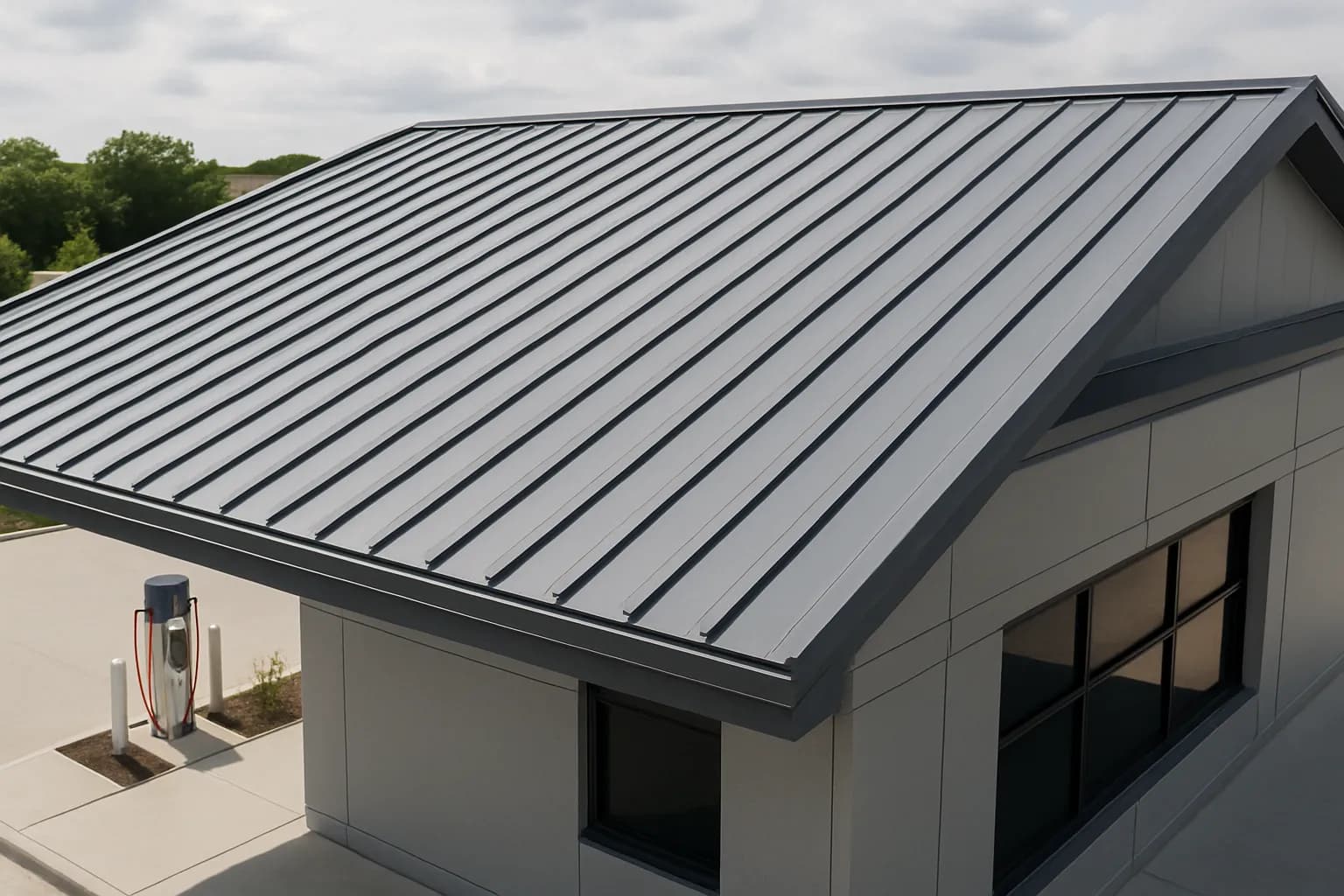
Metal and standing seam roofs
On standing seam or other metal roofs, EV-related conduits often transition from interior electrical rooms to exterior facades or parking structures above grade. Key practices include:
- Use factory-compatible roof boots and grommets that maintain water tightness around conduits.
- Avoid cutting ribs or seams in ways that compromise panel integrity or manufacturer warranties.
- Ensure supports do not create point loads that deform panels or loosen fasteners.
For all roof systems, verify that EV charging station installation plans are reviewed by your roofing manufacturer or approved contractor when warranties are in place.

Permits, Codes, Incentives, and Construction Sequencing
Compliance and incentives can significantly shape both schedule and economics.
Regulatory and safety requirements
Commercial EV charging station installation must follow national and local electrical codes and safety standards.[2][10] Typical requirements include:
- Use of licensed electrical contractors or Licensed Electrical Workers.[2][10]
- Compliance with local EV charging acts or technical references where applicable.[2]
- Adherence to city permitting, fire code, accessibility, and zoning rules.[1][4]
Your EV charging provider or charge point operator (CPO) can help navigate permitting, utility coordination, and inspections.[1][4][10]
Leverage incentives and plan construction
Many regions provide grants, rebates, or tax incentives for commercial EV charging infrastructure.[2][4][6] Before finalizing scope:
- Survey national, state, and utility programs for hardware and installation rebates.[2][4][6]
- Align project phasing with available incentive deadlines.
- Sequence work to minimize disruption to daily operations, especially in high-traffic retail or healthcare facilities.[2]
Installation timelines vary. Site validation and valuation can take two to six weeks; site development and permitting often add one to two months; full engineering, procurement, and construction can range from a few weeks to several months depending on scale.[1][3]
Cost, ROI, and Roof-Related Budget Considerations
Understanding costs and ROI helps property teams decide between limited retrofits and larger, future-proofed installations.
Baseline costs and drivers
For most commercial Level 2 EV charging station installations, owners can expect roughly $6,000–$15,000 per charger, including equipment and installation.[3] Major cost drivers include:
- Number and power level of chargers.[3][4]
- Need for panel or service upgrades and new transformers.[3][4][8]
- Length and complexity of conduit runs, trenching, and any roof crossings.[2][3]
- Permitting and utility fees.[1][3]
- Charging management software and networking.[4][7][9]
Complex projects with extensive utility upgrades or multiple fast chargers can reach well over $100,000, especially for large commercial sites.[3]
ROI, revenue, and roof integration economics
EV charging can enhance property value, improve tenant retention, and generate direct charging revenue.[4][6][9] From a roofing perspective:
- Integrating conduit pathways and penetrations during new construction is significantly less expensive than retrofits, with one study indicating EV-ready infrastructure is far cheaper when designed into initial builds.[5]
- Coordinated penetrations and supports reduce long-term leak risk and repair costs compared with ad hoc field routing.
- Routine roof maintenance post-install helps protect both the EV investment and your building envelope.
Property managers should evaluate whether modest roof repairs and upgrades can be bundled with EV installation to maintain warranties and improve drainage around new infrastructure.
Action Checklist for Property and Facility Managers
Use this checklist to manage EV charging station installation without compromising your commercial roof.
- Define objectives: Amenity vs. revenue vs. fleet support, plus ESG goals.[2][4]
- Engage experts: Select a commercial EV charging provider, electrical engineer, and consult your roofing contractor or manufacturer.[1][4][10]
- Complete site and electrical assessment: Confirm service capacity, panel space, parking patterns, and conduit paths.[2][3][4]
- Map roof interactions: Identify any roof penetrations or crossings on TPO, PVC, EPDM, modified bitumen, BUR, or metal systems.
- Choose charger types and quantities: Level 2 vs. DC fast, aligned with dwell times and user needs.[3][4][8]
- Plan load management and software: Implement smart chargers, dynamic load balancing, and billing integrations.[4][8]
- Confirm permits and incentives: Coordinate with city, fire, and utility authorities; capture available grants and rebates.[1][2][4][6]
- Detail roof work: Approve penetration and flashing details, protection plans, and post-construction inspections.
- Schedule installation: Sequence trenching, electrical work, roof penetration, and commissioning to reduce operational disruption.[1][3][2]
- Monitor and maintain: Use software for performance monitoring and schedule periodic roof and system inspections.
Frequently Asked Questions
What factors most affect the cost of commercial EV charging station installation?
Costs depend on charger type and quantity, electrical capacity, and site layout. Level 2 installations commonly range from $6,000–$15,000 per charger including equipment and labor.[3] Projects needing service upgrades, new transformers, long conduit runs, or multiple DC fast chargers can exceed $100,000 for large commercial sites.[3][4]
How can property managers protect roof warranties during EV charging station installation?
Involve your roofing contractor and, where applicable, the membrane manufacturer in design review. Require approved penetration and flashing details for TPO, PVC, EPDM, modified bitumen, BUR, and metal roofs, and document all work. Post-construction inspections and updated drawings help preserve warranties and minimize future leak or ponding risks.
What is the best way to future-proof EV charging for a multi-tenant commercial building?
Start with a scalable electrical design, leaving capacity for additional chargers, and adopt smart load management so new units can be added without major service upgrades.[2][4][8] Select hardware and software that support open standards (such as OCPP) for flexibility, and plan conduit routes and roof penetrations with expansion in mind.[4]
How long does a typical commercial EV charging station installation take?
After planning and approvals, many Level 2 commercial installations are completed within a few weeks.[3] End-to-end timelines—site validation, permitting, utility coordination, construction, and commissioning—often run from two to several months depending on project scale, grid upgrades, and local regulatory processes.[1][3]
Are EV charging stations a good ROI for offices and retail centers?
Research and market experience indicate that EV charging can increase property attractiveness, support ESG goals, and boost tenant satisfaction, especially in offices, retail, and hospitality settings.[2][4][6][9] ROI comes from higher occupancy, longer dwell times, and potential charging revenue, particularly when incentives reduce upfront installation costs.[2][4][6]
Related Reading on My Roofing Tech
- 2024 IECC Commercial Roofing Impacts for Property Managers
- Commercial Drain Cleaning: Practical Roof Drain Maintenance for Facility Managers
Find a Qualified Commercial Roofing Contractor
Need help acting on this? Browse roofing contractors in your area, or explore commercial roofing services like preventative maintenance, inspections, and emergency response. Are you a contractor? List your business on My Roofing Tech to reach property and facility managers actively searching for help.