 My Roofing Tech
Commercial Metal Roofing: Practical Guide for Facility and Property Managers
Quick Answers for Property & Facility Managers
Is commercial metal roofing worth the higher upfront cost for my building?
Commercial metal roofing often delivers longer service life, lower annual maintenance, and better energy performance than many membrane systems, which can reduce lifecycle costs and capital replacement frequency. For large offices, warehouses, and industrial buildings, the combination of durability, retrofit options, and lower upkeep can make a metal roof a cost-effective long-term investment.
When should a facility manager choose commercial metal roofing instead of TPO or other membranes?
Choose commercial metal roofing when you need long-term durability, low maintenance, strong wind and hail resistance, and potential energy savings from reflective “cool” finishes. Membranes like TPO or PVC are ideal for wide flat roofs, but metal performs particularly well on low-sloped and sloped roofs for offices, retail centers, and warehouses where structural capacity and visibility matter.
What is the best way to address leaks on an aging commercial metal roof?
For aging commercial metal roofs with recurring leaks from fasteners and seams, targeted repairs and sealant replacement can buy short-term time, but a professionally engineered retrofit system—often using single-ply membranes or new metal panels over the existing roof—typically provides a longer-lasting, fully warranted, and more predictable watertight solution.
Why Commercial Metal Roofing Matters for Facility and Property Managers
For offices, retail centers, industrial plants, warehouses, healthcare, and institutional buildings, commercial metal roofing is a strategic asset, not just a construction material. Studies and industry guidance consistently note that metal roofs offer long service life, often several decades, with lower maintenance demands than many other commercial systems.[4][6][10] This translates directly into fewer disruptive replacement projects and more predictable capital planning for facility and property managers.
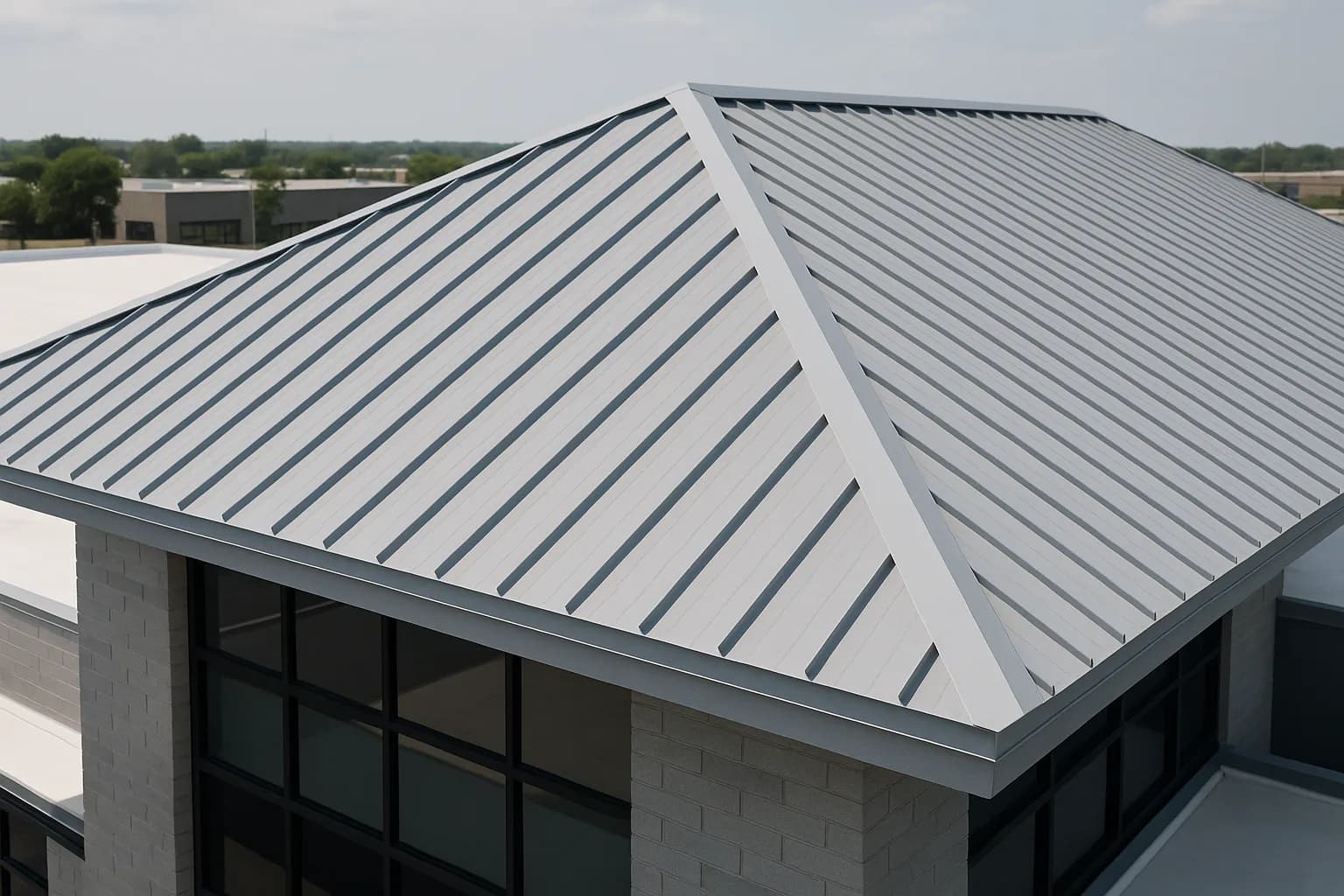
Modern commercial metal roofing—typically standing seam or structural metal panel systems—also supports "cool roof" design. Reflective metal finishes have been shown to reduce cooling energy use and peak demand, particularly in warm climates, delivering measurable operating savings over time.[9][12][13][15] For large conditioned spaces like distribution centers or medical office buildings, this can materially impact utility budgets and net operating income.
Because metal is relatively lightweight and structurally efficient, it can often be used in retrofit applications over existing BUR, modified bitumen, or older metal roofs, avoiding tear-off costs and keeping tenants operational during construction.[3][4][5][11] For managers of multi-tenant office parks or retail properties, this minimal disruption is a key advantage.
Core Benefits of Commercial Metal Roofing vs. Membrane Systems
When evaluating commercial metal roofing alongside TPO, PVC, EPDM, modified bitumen, BUR, and coatings, focus on lifecycle performance rather than just initial bid price. Industry sources highlight several key benefits:
- Service life and durability: Properly designed and maintained metal roofs can last 40–60 years, often outliving alternative systems, while resisting fire, mold, and many mechanical stresses.[4][5][6] Membrane systems typically have shorter design lives, often 20–30 years depending on product and maintenance.[2][4]
- Lower maintenance burden: Annual maintenance costs for commercial metal roofs are commonly cited in the range of about $0.03–$0.08 per square foot per year, compared with roughly $0.05–$0.15 per square foot for many membrane roofs, resulting in 30–50% lower upkeep.[4] This is especially meaningful across large portfolios.
- Energy performance: Reflective, "cool" metal roofs have been shown in research to reduce cooling energy use by double-digit percentages in hot climates, with some studies reporting 18–26% cooling energy reduction and significant peak demand savings.[9][12][13][14][15] Compared with traditional dark BUR or aged membranes, metal can maintain reflectivity over time.[13]
- Structural and retrofit flexibility: Metal's light weight and ability to function as a structural deck support its use in retrofit systems installed over existing roofs, preserving the underlying structure and reducing landfill disposal.[2][3][4][5]
- Storm and impact resistance: Metal panels do not crack, rot, or support algae growth, and can be engineered for high wind uplift and hail resistance—valuable for industrial and logistics facilities in exposed locations.[10]
For facility managers, the implication is clear: commercial metal roofing generally carries a higher upfront project cost than many membranes, but delivers extended lifespan, lower annual maintenance, and potential energy savings that can materially improve total cost of ownership.[4][6][13]
Commercial Metal Roofing vs. TPO, PVC, EPDM, Modified Bitumen, BUR
Most portfolios mix roof types: wide, flat warehouse roofs may use TPO or PVC membranes; smaller sloped roofs on office entries or retail pads may use standing seam metal; older institutional buildings might still have BUR or modified bitumen. Understanding how metal compares helps you choose the right system for each asset.
- TPO (Thermoplastic) and PVC membranes: These are highly popular for flat and low-slope roofs due to their continuous watertight sheets, welded seams, and strong reflectivity. They are excellent for large, open-span roof decks and can be used in metal retrofit systems where a single-ply membrane is installed over an existing metal roof to solve seam and fastener leaks.[2]
- EPDM (rubber): EPDM offers proven longevity and flexibility, particularly in colder climates, but is usually dark and less reflective unless combined with coatings. It is common on older office and institutional roofs.
- Modified bitumen and BUR (built-up roofing): These asphalt-based systems provide multi-ply redundancy and have long histories on low-slope commercial roofs. However, they are heavier, often darker (reducing energy performance), and can require more intensive maintenance over time.
- Metal / standing seam: Metal excels where roof slopes, architectural visibility, and robustness matter, such as office façades, retail and hospitality entrances, and many industrial buildings. It can also be used as part of a retrofit assembly installed over existing BUR or modified bitumen roofs, combining metal framing and insulation with a new roof surface.[1][3][4]
From a portfolio strategy standpoint, facility and property managers can deploy commercial metal roofing where long-term durability, low maintenance, and appearance justify the higher initial investment, and use membranes for very large, flat decks where cost and installation speed are critical.
Repair, Retrofit, or Replacement: Practical Decision Framework
Aging commercial metal roofs often exhibit leaks at fasteners, seams, penetrations, and degraded sealant points, rather than widespread panel failure.[2][3][5] Your key decision is whether to continue repairing, apply coatings, or invest in a full retrofit or replacement.
Step 1: Conduct a condition assessment
- Document leak locations, rust and corrosion, loose or backed-out fasteners, failed sealants, and seam movement.
- Review manufacturer warranty status and maintenance records to understand your obligations and history of issues.
- Evaluate insulation performance, condensation, and energy use patterns—especially for conditioned spaces.
Step 2: Short-term repairs vs. coatings
Targeted repairs can resolve local issues: replacing fasteners, re-sealing joints, and addressing isolated corrosion. For short-term budget constraints, elastomeric or acrylic coatings may offer temporary improvement in watertightness and reflectivity. However, industry sources emphasize that coatings typically do not address root causes such as fastener back-out or panel movement, and often require recurring recoating and repairs.[2]
Step 3: Evaluate a retrofit system
Professionally engineered retrofit systems are designed to solve core leak drivers and deliver a new, fully warranted roof without tearing off the existing metal.[2][3][5][11] Two common approaches include:
- Metal-over-metal retrofit: A new lightweight metal panel system is installed over the existing roof using a sub-framing assembly, often with added insulation. This approach preserves the original roof as a structural deck and can extend service life beyond 40 years with proper care.[1][3][5]
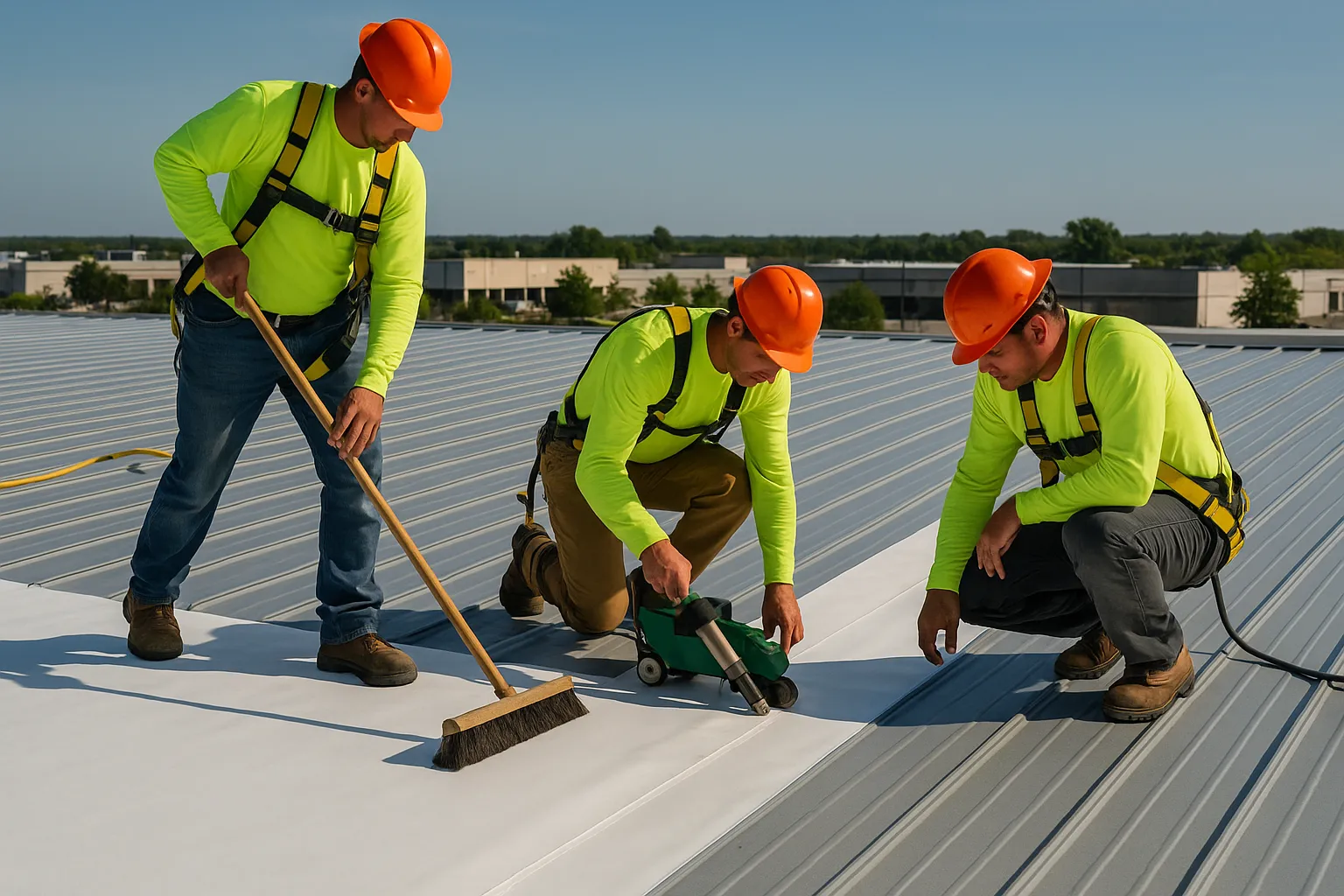
- Single-ply membrane retrofit over metal: A new TPO or PVC membrane is installed over the existing metal roof, eliminating thousands of exposed fasteners and seams that are common leak sources.[2] The continuous membrane surface improves watertightness and allows for insulation upgrades, boosting energy performance.
Compared to coatings, retrofits generally have higher upfront cost but deliver longer-term watertight performance, stronger manufacturer-backed warranties, and lower lifecycle cost because they avoid repeated recoating and reactive leak repairs.[2][3]
Step 4: Full replacement considerations
Full removal and replacement of a commercial metal roof is typically warranted when structural corrosion is significant, panel integrity is compromised, or the existing design cannot support required loads or code updates. Removal adds tear-off and disposal costs and can disrupt operations, while retrofits often allow business continuity with minimal interior exposure.[3][11] For occupied offices, healthcare, and retail buildings, minimizing disruption is often a decisive factor.
Maintenance Checklist for Commercial Metal Roofing
Even though commercial metal roofing is relatively low maintenance, structured preventative care is essential to preserve warranties and maximize service life.[4][6][10]
Biannual inspection checklist
- Inspect all panels for damage, rust, or coating degradation, especially at edges and panel laps.
- Check fasteners for back-out or loose conditions; tighten or replace as needed.
- Evaluate sealants at seams, end laps, penetrations, and flashings; replace aged or cracked sealant.
- Assess gutters, downspouts, and drainage for debris or blockages that cause ponding near transitions.
- Review roof transitions where metal interfaces with TPO, PVC, EPDM, modified bitumen, or BUR systems, paying close attention to flashing integrity.
Annual maintenance actions
- Clean gutters and drains to ensure proper water flow and prevent standing water near parapets or curbs.
- Remove debris that can trap moisture or cause abrasion on the coating surface.
- Perform spot touch-up of protective coatings where bare metal is exposed to reduce corrosion risk.
- Update roof documentation, including photos and inspection reports, to support warranty claims and budgeting.
For facility and property managers, the goal is to keep annual maintenance planned and predictable rather than reactive. With typical annual cost ranges lower than membranes, this proactive approach reinforces the lifecycle value of commercial metal roofing.[4]
Cost, ROI, and Portfolio Planning for Commercial Metal Roofing
Accurate installed cost varies by market, building geometry, and structural requirements, so managers should rely on current bids from qualified commercial roofing contractors. However, multiple industry sources emphasize that while metal roofs often carry higher initial project costs than membrane systems, they can yield lower total lifecycle cost due to longer life, reduced maintenance, and energy savings.[4][6][13]
Research on cool metal roofs has documented significant energy savings versus traditional built-up roofs and dark surfaces, with some analyses indicating that energy savings can allow the roof to pay for itself within part of its 30–50-year life span.[13][15] In hot climates, cool roofs—including reflective metal systems—have been shown to reduce air-conditioning energy use and, in some cases, deliver up to ~20% or more energy cost reductions.[9][12][14][15] These savings are particularly impactful on large conditioned buildings such as distribution centers and medical office buildings.
From a capital planning perspective, commercial metal roofing can be positioned as a long-term asset:
- Capex vs. Opex: Higher upfront capex is offset by lower annual opex (maintenance and energy), and fewer full replacement cycles over the asset life.[4][6]
- Risk management: More robust wind, fire, and impact performance supports resilience goals and may influence insurance considerations.[5][6][10]
- Tenant and brand impact: Visible architectural metal roofs on offices, retail, and institutional buildings can support branding and market perception.
For portfolio owners, mapping roof type, age, and condition across assets and aligning replacement strategies—metal where long-term ROI and visibility matter; membranes where large flat decks dominate—can materially improve budget predictability and property values.
Frequently Asked Questions
How does commercial metal roofing affect lifecycle cost compared to TPO or PVC?
Industry data indicates that commercial metal roofs typically have longer service lives—often several decades—with annual maintenance costs reported in the range of roughly $0.03–$0.08 per square foot, versus about $0.05–$0.15 for many membrane roofs.[4] Combined with proven cool-roof energy savings, this can produce lower lifecycle cost despite higher initial installed pricing.[4][6][13]
Is a metal roof retrofit better than applying roof coatings on an aging commercial metal roof?
Coatings can temporarily improve watertightness and reflectivity but typically do not resolve core issues like fastener back-out and panel movement.[2] Engineered metal or single-ply retrofit systems installed over the existing roof eliminate many leak sources, allow insulation upgrades, and offer stronger manufacturer warranties, resulting in more predictable long-term performance and lower lifecycle cost than repeated recoating.[2][3][5]
Can commercial metal roofing be installed over existing BUR or modified bitumen roofs?
Yes, many retrofit metal roof systems use sub-framing and new metal panels installed over existing BUR or modified bitumen roofs.[1][3][4] This approach avoids tear-off and disposal costs, preserves the old roof as a structural deck, and allows insulation upgrades. It also reduces disruption to building operations, which is critical for occupied offices, retail, and healthcare facilities.[3][5][11]
What energy savings can facility managers expect from cool commercial metal roofs?
Reflective cool metal roofing has been shown in studies to reduce cooling energy use and peak demand compared with dark roofs, with reported cooling reductions in the range of roughly 18–26% in some applications.[9] Other research suggests cool roofs can cut air-conditioning energy use and energy bills by significant margins, particularly in hot climates.[12][13][14][15] Actual savings depend on climate, building design, and HVAC systems.
How often should commercial metal roofs be inspected and maintained?
Industry guidance typically recommends at least two inspections per year for commercial metal roofs, plus additional checks after major storms.[4] Routine tasks include gutter cleaning, fastener and sealant checks, debris removal, and minor coating touch-ups. With this proactive maintenance, metal roofs can maintain low annual upkeep costs and extended service lives, supporting warranty compliance and budget predictability.[4][6][10]
Related Reading on My Roofing Tech
- Royalty Roofing USA Acquires Tingley Roofing: What Commercial Property Managers Need to Know
- Florida Building Code Corrosion Resistance: What Facility Managers Need to Know
Find a Qualified Commercial Roofing Contractor
Need help acting on this? Browse roofing contractors in your area, or explore commercial roofing services like preventative maintenance, inspections, and emergency response. Are you a contractor? List your business on My Roofing Tech to reach property and facility managers actively searching for help.