 My Roofing Tech
Flat Roof Replacement Guide for Commercial Buildings: Systems, Costs, and ROI
Quick Answers for Property & Facility Managers
When does a commercial flat roof need full replacement instead of repair?
A commercial flat roof replacement is usually justified when leaks are widespread, the membrane is near or past its service life, there is saturated insulation, recurring ponding water, or chronic flashing failures. At that point, targeted repairs become less cost-effective than installing a new compliant system with a long-term warranty.
How much does commercial flat roof replacement cost per square foot?
Most commercial flat roof replacement projects fall roughly in the $11–$18 per square foot installed range, including tear-off, insulation, membrane, flashing, and drain improvements, with single-ply TPO, PVC, and EPDM often on the lower end and BUR or complex metal details on the higher end.[5]
Which flat roof system is best for an office, warehouse, or healthcare facility?
System choice for flat roof replacement depends on building use, foot traffic, chemical exposure, and budget. TPO and PVC are common for energy-efficient offices and retail, EPDM for large warehouses, modified bitumen and BUR for durability, and metal or coatings for specific slope or re-cover situations.[8][5]
Flat roof replacement basics for commercial facility and property managers
For commercial office, retail, industrial, healthcare, and multifamily properties, a flat roof replacement is one of the largest capital projects you will manage. It affects building watertightness, energy performance, tenant satisfaction, and future operating budgets. Planning it methodically reduces risk and maximizes ROI.
Industry guidance from organizations such as NRCA emphasizes that low-slope roofs (slopes at or below 3:12) rely on continuous membranes, positive drainage, and robust flashing details.[11][15] When these elements fail extensively, a full flat roof replacement often becomes more economical than ongoing repairs.
This guide focuses on what facility and property managers need to know: how to decide between repair and replacement, how to structure the project, and how to compare major flat roof systems—TPO, PVC, EPDM, modified bitumen, BUR, metal, and coatings—on performance, cost, and warranty.
When to choose flat roof replacement vs. repair or maintenance
Every decision should start with a professional condition survey of your existing roof system. Technical guidance notes that a replacement project begins with assessing the deck, insulation, drainage, and waterproofing to determine whether a re-cover is possible or a full tear-off is required.[6][2]
Key indicators that replacement is warranted
- End-of-life membrane: When single-ply membranes (TPO, PVC, EPDM) or asphalt systems (modified bitumen, BUR) near their expected service life—typically around 20–30 years depending on type—age-related failures multiply, making repairs less effective.[5][11]
- Widespread leaks and saturated insulation: Infrared surveys and core cuts that show extensive moisture in insulation or the deck are a strong indicator for flat roof replacement because wet insulation destroys R-value and accelerates deck deterioration.[11]
- Chronic ponding water: NRCA recommends positive drainage on low-slope roofs; persistent ponding indicates structural or drainage deficiencies that are best corrected during replacement with tapered insulation or additional drains.[15][11]
- System incompatibility or non-compliance: Older roofs may not meet current energy codes, fire ratings, or wind uplift requirements. Upgrading via replacement can help compliance while reducing insurance risk.[2][10]
When repair and maintenance still make sense
Targeted commercial roof repairs typically cost in the low single-digit dollars per square foot range for many systems, significantly less than full replacement.[13] When damage is localized—such as isolated punctures, small flashing failures, or minor seam splits—repair combined with a formal roof management program (annual walkovers, post-storm inspections, drainage checks) can extend service life.[11][13]
For facility managers, the decision point is usually reached when annual leak repairs and associated interior damages approach the financing cost of a new system. At that stage, a planned flat roof replacement is often the better long-term financial choice.

Step-by-step process to manage a flat roof replacement project
Commercial flat roof replacement follows a relatively consistent sequence across building types. Understanding the process helps property managers control scope, schedule, and disruption.
1. Condition survey and strategy
- Engage a qualified roofing consultant or reputable commercial contractor to perform a walkover, moisture scans (where applicable), and core cuts.[6][11]
- Document deck type, existing insulation, membrane, flashings, penetrations, and drainage conditions. This determines whether a re-cover, partial tear-off, or full replacement is feasible.[2]
- Align roof strategy with asset plan: hold period, tenant mix, future rooftop equipment needs, and ESG/energy objectives.
2. System selection and specification
- Compare suitable low-slope systems using credible materials guides (e.g., NRCA’s commercial low-slope materials listings).[4][8]
- Evaluate wind uplift ratings, fire ratings, and manufacturer warranty options for your climate and building use.[2]
- Develop a written specification covering deck prep, insulation type and thickness, membrane type and thickness, fastening pattern, flashing details, and drainage improvements.
3. Permits, compliance, and procurement
- Obtain required building permits and inspections; many jurisdictions require stamped drawings for structural changes or significant insulation upgrades.[1][12]
- Prequalify contractors with documented commercial experience, safety programs, and manufacturer certifications for the systems being bid.
- Issue a detailed RFP including drawings, specification, expected schedule, phasing requirements, and warranty targets, then compare apples-to-apples proposals.
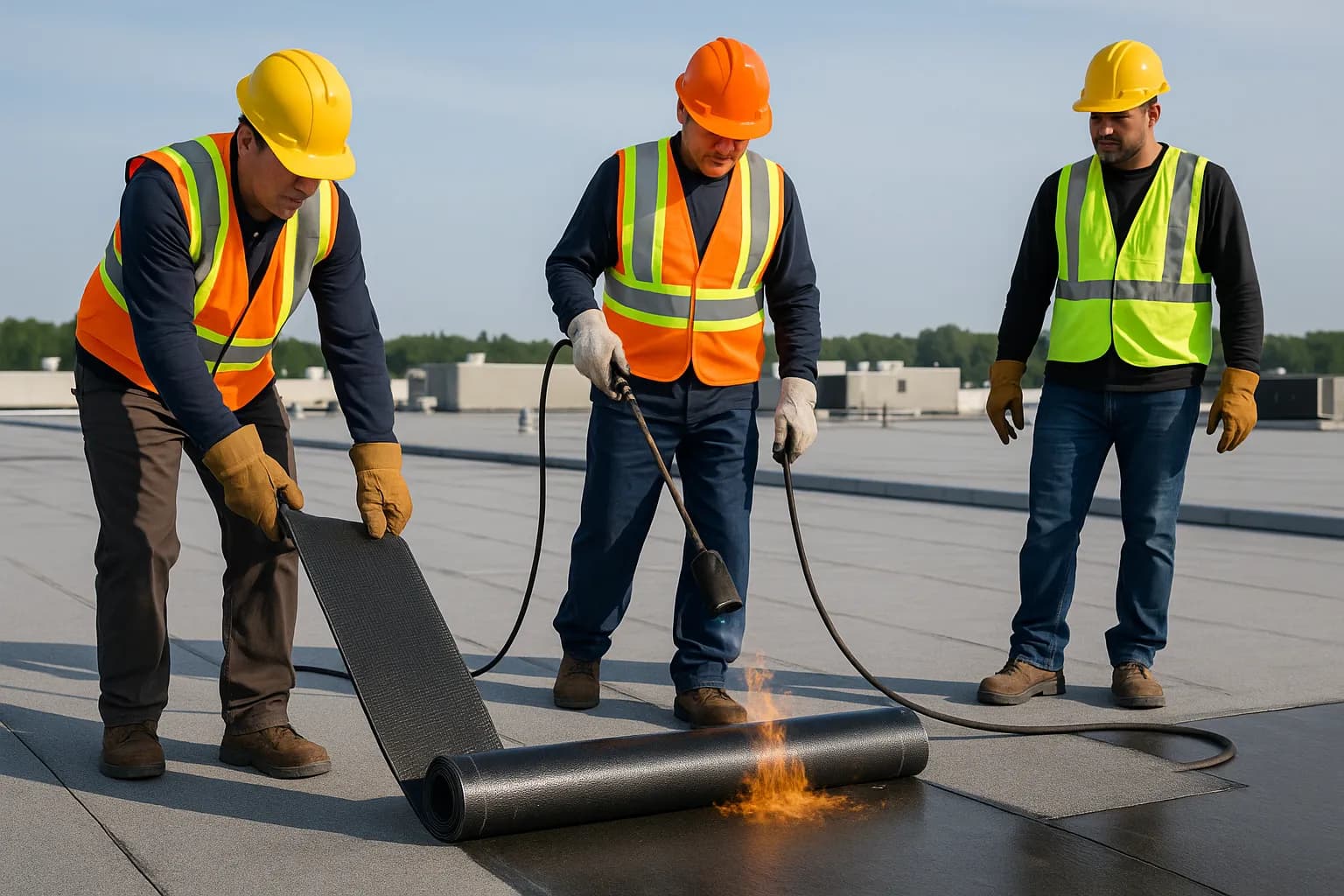
4. Tear-off, deck repairs, and insulation installation
- Coordinate access, staging, and tenant communication; expect noise and temporary disruptions.
- Existing membranes and saturated insulation are removed as specified; NRCA guidance stresses inspecting wood blocking and deck for deterioration, straightness, and fastening capacity, replacing inadequate components.[2]
- New insulation—often polyiso—is installed to meet energy code, using tapered layouts where needed to improve drainage.[11]
5. Membrane, flashing, and drainage upgrades
- Chosen membrane (TPO, PVC, EPDM, modified bitumen, BUR, or metal panels) is mechanically attached, adhered, or ballasted per specification.[8]
- Critical flashings at parapets, curbs, wall transitions, and penetrations are installed with manufacturer-approved details.
- Drains, scuppers, and overflows are repaired or replaced to achieve positive drainage and code-compliant overflow capacity.[15]
6. Testing, punch list, and warranty handover
- Contractor performs water testing where appropriate and completes punch list items.[6]
- Obtain manufacturer’s warranty, contractor warranty, as-built drawings, and maintenance requirements.
- Integrate roof into your formal roof management program, including annual inspections and documentation after severe weather events.[11]
Comparing major commercial flat roof replacement systems
Different roof systems perform best in different building contexts. A national guide to commercial flat roofing systems outlines the main categories: single-ply membranes (TPO, PVC, EPDM), multi-layer asphalt systems (modified bitumen, BUR), metal panel roofs, and liquid-applied coatings.[8]
TPO (Thermoplastic Polyolefin)
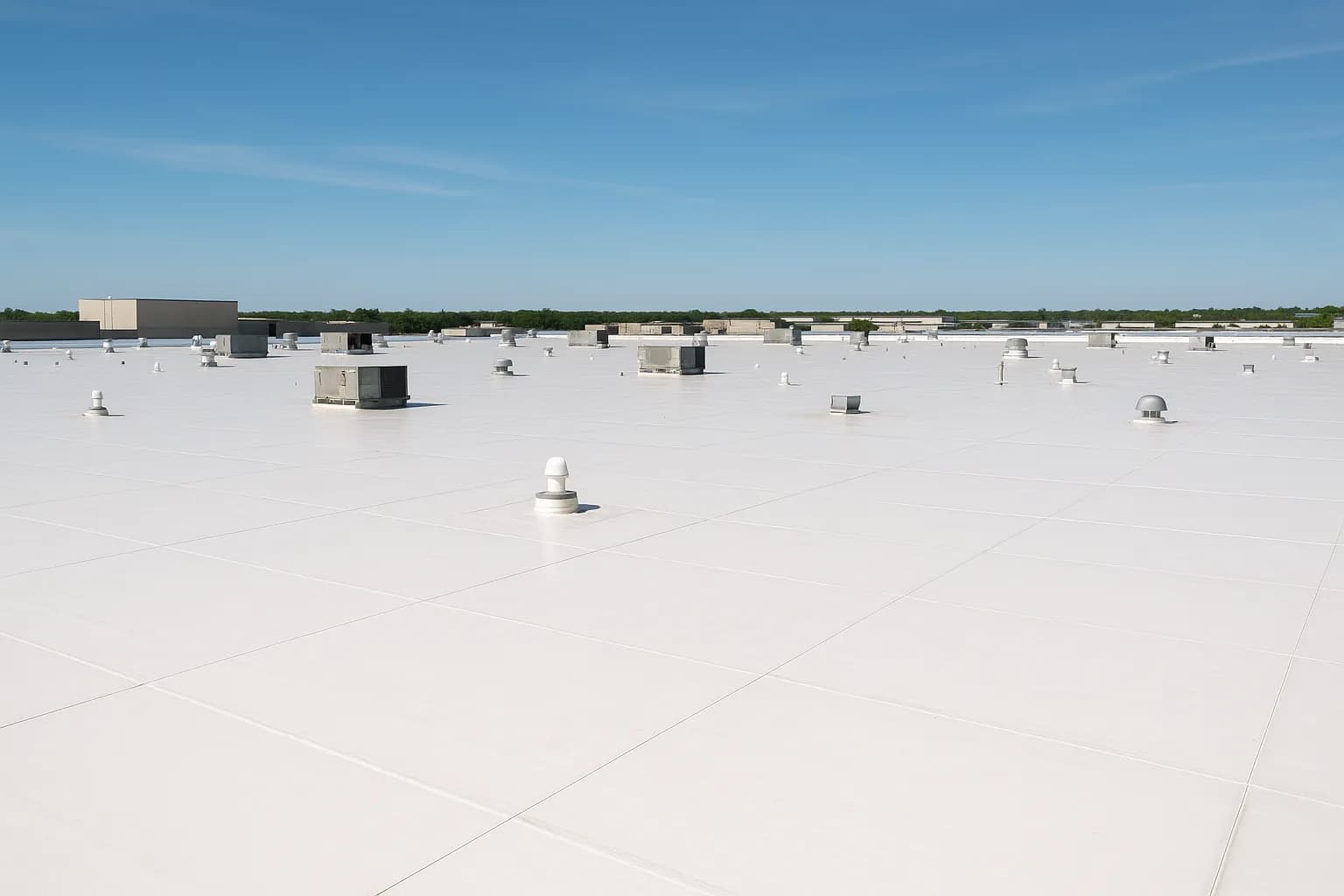
- Use cases: Widely used on offices, retail, and institutional buildings seeking white reflective roofs and strong manufacturer warranty options.
- Cost and service life: A 60-mil TPO system often installs in roughly the low-teens dollars per square foot range with expected life in the 20–25 year range.[5]
- Considerations: Ensure proper detailing at seams and flashings; UV resistance and formulation quality vary by manufacturer, so stick to established brands and certified installers.
PVC membrane
- Use cases: Common on restaurants, healthcare, and industrial facilities where chemical resistance and heat-welded seams are valued.
- Cost and service life: Frequently at a slight premium to TPO, with many 60-mil PVC systems targeting 25–30 year service lives when well installed.[5][8]
- Considerations: Verify compatibility with existing materials and foot-traffic protection; choose assemblies meeting fire and wind requirements for your occupancy.
EPDM (rubber)
- Use cases: Popular for large warehouses and distribution centers due to wide sheets, fewer seams, and proven long-term performance.[8]
- Cost and service life: Installed costs generally comparable with TPO and PVC; many 60-mil EPDM systems are designed for service lives exceeding 20 years.[5][11]
- Considerations: Black EPDM absorbs heat; this can be positive in cold climates but increases cooling loads in hot climates unless mitigated with coatings or insulation.
Modified bitumen and Built-Up Roofing (BUR)
- Use cases: Multi-layer asphalt systems are often used where robustness against foot traffic, hail, or mechanical abuse is valued, such as industrial or institutional campuses.[8]
- Cost and service life: Installed costs can be in a similar or slightly higher band than single-ply systems, with typical life expectancies in the 15–30 year range depending on configuration.[5]
- Considerations: Heavier weight and more complex installation. Ventilation, fire safety, and odor management are project considerations for occupied buildings.
Metal / standing seam for low-slope
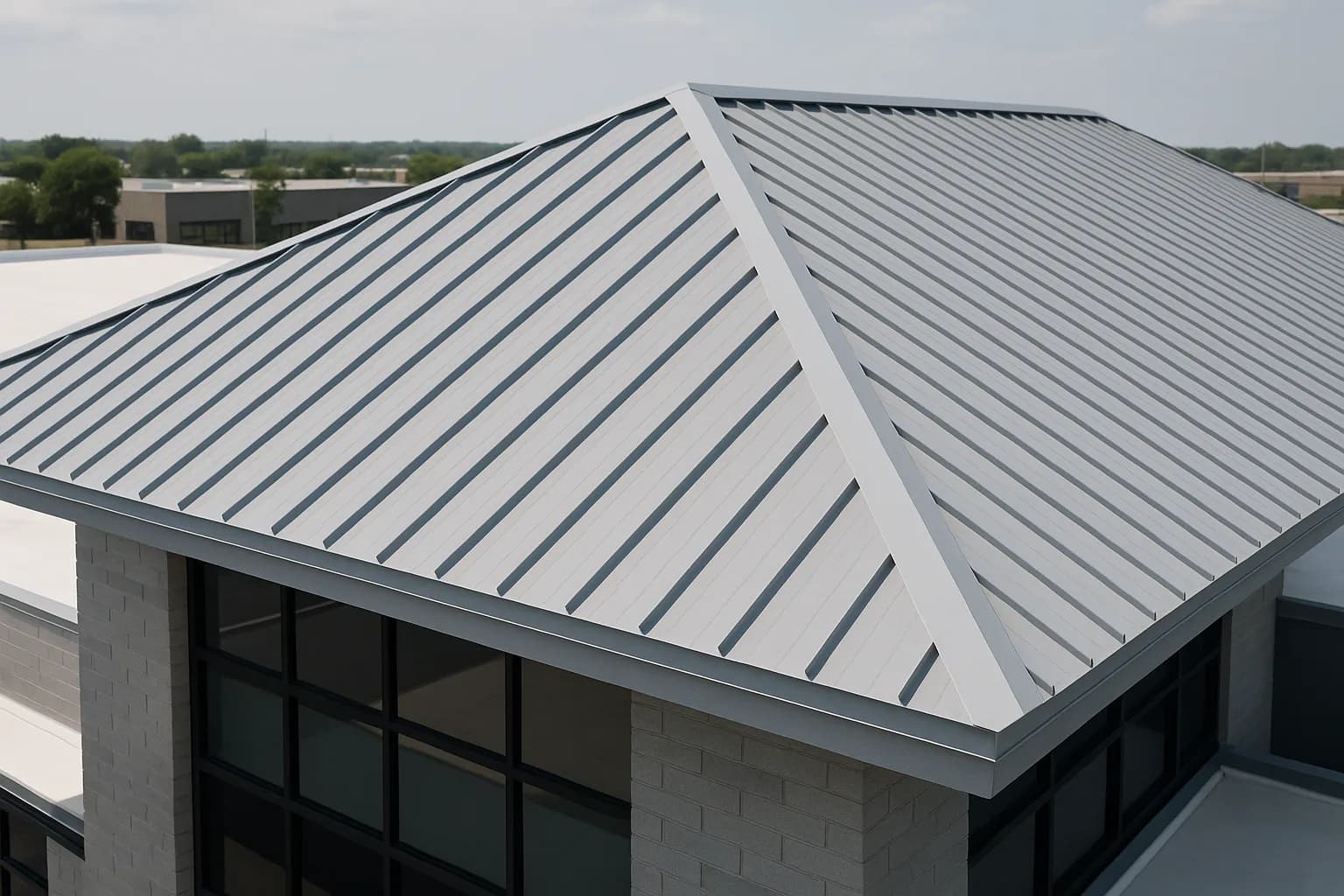
- Use cases: Structural metal panel systems are used on low-slope roofs where long spans, durability, and architectural aesthetics are desired, often on distribution or institutional facilities.
- Slope requirements: NRCA recommends minimum slopes of 1/2:12 for structural metal panel systems, increasing to 3:12 or more for architectural panels.[15]
- Considerations: More sensitive to detailing at transitions and penetrations; not always suitable for very low-slope retrofit without careful design.
Roof coatings and re-cover options
- Use cases: Elastomeric coatings can extend life of sound membranes and improve reflectivity when the underlying system is still structurally and watertight sound.
- Limitations: Coatings are typically not a substitute for flat roof replacement when there is extensive wet insulation, structural damage, or systemic flashing failure; they may also have more limited warranties.

Cost, warranty, and ROI considerations for flat roof replacement
From a capital planning perspective, you should consider cost per square foot, expected service life, warranty terms, and how the new system impacts operating expenses.
Cost ranges and project scale
- Installed cost: Recent cost calculators and contractor data suggest many full flat roof replacement projects—including tear-off, new insulation, membrane, parapet flashings, and drain work—land in an approximate $11–$18 per square foot installed range, depending on system type and complexity.[5][7]
- Repairs vs. replacement: Typical repair costs for common systems (EPDM, modified bitumen, BUR, PVC) range around a few dollars per square foot, scaling with damage extent and emergency response premiums.[13]
- Project scale: For a 50,000-square-foot warehouse, even a $12 per square foot project represents a $600,000 investment. For multi-building portfolios, staggering replacements based on condition assessments and warranty timelines is critical.
Warranty and risk management
- Manufacturer warranties: Many commercial systems offer 20–30 year warranties when installed by certified contractors and maintained per guidelines, but coverage is contingent on adherence to design, installation, and maintenance requirements.[8][11]
- Contractor warranties: Shorter-term workmanship warranties (often 2–5 years) supplement manufacturer coverage and should be aligned with your roof management plan, including a pre-expiration survey and repairs.[11]
- Risk reduction: A new, warrantied roof reduces leak-related business interruption, tenant complaints, and interior damage, and may improve insurability and valuation.
Operational savings and ROI
- Energy performance: Upgrading insulation to meet current energy codes and selecting reflective membranes (such as white TPO or PVC) can reduce cooling loads, especially for large conditioned spaces.[8]
- Maintenance efficiency: Modern systems with well-designed drainage and access points simplify inspections and repairs. Formal roof management programs, including annual surveys and documentation after major storms, are associated with extended service life.[11]
- Portfolio perspective: For property managers and asset managers, the ROI calculus includes avoided emergency repairs, reduced tenant churn due to leaks, and improved underwriting for long-term holds or dispositions.
Action checklists for facility and property managers
Pre-project planning checklist
- Assemble existing roof records: drawings, warranties, leak logs, prior reports.[11]
- Commission a condition survey (consultant or qualified commercial roofer) including moisture scans where applicable.[6]
- Decide on hold period and capital budget; prioritize buildings with high leak frequency or near-expired warranties.
- Establish performance goals: energy efficiency, warranty term, tenant impact, sustainability.
- Confirm code requirements for insulation, drainage, and fire ratings with design professionals.[2][10]
Bid and contractor selection checklist
- Issue a clear scope and specification, including system type options and acceptable manufacturers.[4][8]
- Require evidence of manufacturer certification, references for similar-size projects, and safety records.
- Compare proposals on total system cost (not just membrane), warranty terms, schedule, and phasing plan.
- Verify insurance, licenses, and bonding, and ensure contractors understand occupancy constraints (e.g., healthcare, data centers).
Post-installation management checklist
- Collect all warranties, as-builts, and maintenance manuals; upload to your asset management system.[11]
- Schedule annual roof walkovers and post-storm inspections, documenting conditions and minor repairs.[11]
- Maintain clear rooftop access controls and policies for new equipment installations.[11]
- Plan a warranty pre-expiration survey with your roofing consultant to address any emerging issues and preserve coverage.
Frequently Asked Questions
What is the typical ROI on a commercial flat roof replacement?
ROI on commercial flat roof replacement comes from reduced leak risk, lower emergency repair costs, improved energy performance through upgraded insulation and reflective membranes, and stronger warranties. For facility managers, evaluating avoided damage costs, potential rent protection, and asset value impact over a 20–30 year horizon is more meaningful than simple payback.
How should facility managers compare flat roof replacement bids?
Compare bids on full system scope, not just membrane price: tear-off, insulation thickness, tapered design, flashing details, drains, safety measures, and warranty term. Require manufacturer-approved details and certified installers. Normalize proposals to the same warranty length and system type to make a true apples-to-apples decision.
What are the biggest risks if we delay flat roof replacement too long?
Delaying needed flat roof replacement can lead to structural deck damage, widespread insulation saturation, mold or indoor air quality issues, and disruptions to tenants from repeated leaks. Insurance claims and business interruption exposures also increase. At some point, cumulative repair and damage costs exceed the cost of a planned replacement.
Do we always need a full tear-off for flat roof replacement?
Not always. If the existing deck is sound and moisture surveys show dry insulation, a re-cover system may be feasible under current codes and manufacturer rules. However, extensive wet insulation, deteriorated decking, or multiple existing layers often require full tear-off. A professional condition survey is essential to make this determination.
How do warranties work for TPO, PVC, and EPDM flat roof replacement systems?
Manufacturers typically offer 20–30 year warranties on TPO, PVC, and EPDM systems when installed to specification by certified contractors and maintained per guidelines. Coverage focuses on membrane performance, while contractors cover workmanship for shorter periods. Facility managers must follow inspection and maintenance requirements to keep warranties valid.
What should property managers communicate to tenants during flat roof replacement?
Property managers should notify tenants about schedule, access changes, noise, and any temporary closures well in advance. Coordinate protection of sensitive areas, confirm emergency egress is maintained, and provide a single point of contact for issues. Clear communication reduces friction, preserves tenant relationships, and helps the project proceed smoothly.
Related Reading on My Roofing Tech
- TopBuild to Acquire Progressive Roofing: What Facility Managers Need to Know
- Commercial Roof Leak Repair: Step‑By‑Step Guide for Facility Managers
Find a Qualified Commercial Roofing Contractor
Need help acting on this? Browse roofing contractors in your area, or explore commercial roofing services like preventative maintenance, inspections, and emergency response. Are you a contractor? List your business on My Roofing Tech to reach property and facility managers actively searching for help.